Blood Root Valley
Located between Rockland Avenue and Manor Road in Staten Island, NY 10306.
History
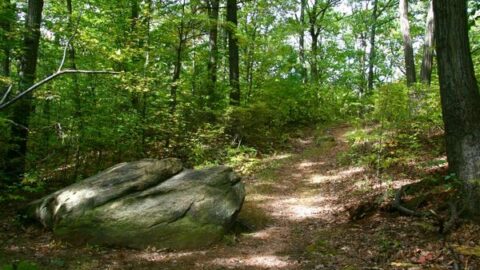
The landscape of Blood Root Valley still bears the marks of the last Ice Age. When glaciers receded about 12,000 years ago, they left behind kettle holes, steep hills, and scattered boulders, along with varied soils that now support a wide diversity of plants and animals.
Part of this area was also once the site of the NYC Farm Colony complex and Seaview Hospital. The Farm Colony was established in 1829 as the “Richmond County Poor Farm,” and offered its residents work in exchange for room and board. Seaview Hospital, constructed in 1913 and merged with the Farm Colony in 1915, operated as a major tuberculosis sanatorium. It was here that Dr. Edward H. Robitzek (1912–1984), a Staten Island lung specialist, conducted groundbreaking drug trials in the 1950s that helped establish treatments for tuberculosis still in use today. The facility closed in 1975 and was reopened under NYC Health and Hospitals during the early 2000s.
Today, Blood Root Valley has become a central feature of the Staten Island Greenbelt.
How Did This Site Become A Park?
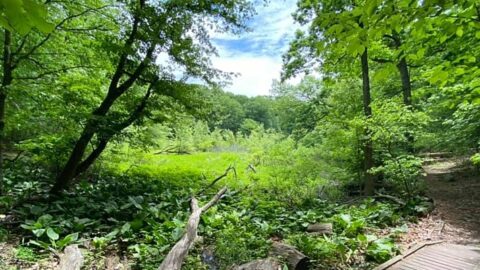
In 1994, the City of New York assigned this property to NYC Parks, officially making Blood Root Valley part of the Staten Island Greenbelt. Blood Root Valley has become especially valued for its ecological diversity. Its landscape features mature forests, shrub thickets, open woodlands, old fields, meadows, and grasslands. Among the many wildflowers are rare species such as blue cohosh, Virginia waterleaf, and sweet cicely.
The area also provides a habitat for hundreds of animal species, including several endangered or threatened birds like the peregrine falcon and red-shouldered hawk. It is one of only three sites in New York State where the arogos skipper, a small butterfly listed by the New York State Natural Heritage Program as rare, can still be found.
Behind the Name
This site is named for the bloodroot plants that thrive throughout the property. It also contains the only wild population of this plant in all of Staten Island. A member of the poppy family, the bloodroot is an early spring flower whose name refers to the deep red color of its sap. For about a week between March and May, it produces a delicate white flower blossom that often lasts only a day or two before a strong wind or a heavy spring shower ends its brief display. Other names for the plant include snakebite, sweet slumber, corn root, turmeric, and tetterwort.
Over the centuries, bloodroot has proven to be an incredibly versatile plant. Native Americans used its red sap as a natural dye for decorating skin, baskets, tools, and clothing. European colonists later adopted this practice, using the plant to color wool.
Bloodroot was also valued for its medicinal properties. Various Native American tribes used it to treat fevers and rheumatism. In the 19th century, physicians in London, learning of these practices, experimented with bloodroot and combined it with other chemicals to treat skin cancers, though this approach was discontinued by the end of the century.
Directions
For directions to Blood Root Valley, please see Google Maps.